


Warmwater Fishes of Brazil Vol. 1: Peacock Bass Species

It is surely ambitious of me to suggest by the title above that I will be covering all warmwater game fishes of Brazil. To keep our expectations under control, I will not be covering all warmwater species in one blog, or even in a series of blogs; but, I do mean to cover, in a series of blogs, the brazilian warmwater species that are, for one reason or another, more meaningful to me, as a fly angler.
To be more specific, my plan for this particular blog series is to focus on 1) freshwater fishes, 2) fish species that may be of some interest to fly anglers (not to aquarium enthusiasts) and 3)species found in Brazil. Even by narrowing the scope I will not even get close to scratch the surface of this subject.
However, my goal is humble. If you can get out of this read, with some new knowledge about Warmwater Fishes of Brazil, then I am a happy camper!
Let's start off with the most popular fish in Brazil amongst anglers, the Peacock Bass. People from all over Brazil and all over the world travel to the Amazon to catch a trophy size Peacock Bass, the famous "Temensis", the "Açu" (pronounced "Ah-Soo"). A grown "Açu" can exceed 36" and sometimes weighs over 20 lbs. Although the "Açu" became almost a synonym for Peacock Bass, it is just one of the several Peacock Bass species in catalog. To be fair, there are 15 different officially recognized species of Peacock Bass, and currently, one additional species is under evaluation.
Before we start talking about some of these Peacock Bass species, I would like permission to clear the room and clarify that Peacock Bass is not a "Bass" of any kind - not a Bass at all! Just like Smallmouth Bass and Largemouth Bass are also not a Bass (they belong to the sunfish family), the Peacock Bass are part of the Cichlids (pronounced "Si-kluhds") family, same as the Tilapias. Having said that, it is understandable why it has been named after a "Bass" in the english-speaking world. Its large mouth, its predatorial behavior, its body shape, all of that, do remind a Bass! And perhaps, a good marketing strategy, since Bass fishing is popular in the 4 corners of this world. But now, why "Peacock" Bass? In Brazil, this species has a name that comes from the indigeous Tupi-Guarani language, it's called "Tucunaré", which means "Friend of the Trees" ("Tucum":Tree + "Aré": Friend), and there is no "Peacock" (as in the bird) allusion to its name at all. Interesting enough, in the Spanish-speaking world, the fish is also called "Pavon", which translates to Peacock. So, there is goes, now everything kind of makes sense, all things considered. And, to be honest, the glamorous looks and imponent behavior of a Peacock Bass, does resembles the bird. The scientific name for the entire Peacock Bass familly is "Cichla"; but, when in Brazil, call it "Tucunaré", "Tucuna" or "Açu", if you want to be understood.
Back to the Peacock Bass Species, as different as they can be from the popular Temensis, it's hard to miss they are a Peacock Bass. They will all have an Ocellaris (that round dark shape on the tail, like in a Redfish), they will have similar body shape, strong appetite and they will always be very aggressive and territorial. On this blog, I will go over eight of the species, some of which may be new to you.

Cichla Temensis ("Açu")
The "Açu" is very easy to recognize, it goes beyond its brute force and aggressive take, it has three vertical black parr marks on its side, from top to bottom; and a very well-defined war-paint on its face (in Brazil, we call it a "map"). Its body colour may be bright yellow or it may be brownish (or speckled), depending on its mood. In many cases, it will have red devilish eyes.


Cichla Vazzoleri
"Açu" means big, in the indigenous Tupi-Guarani language. Normally, we use it to refer to the "Temensis", but truth is, by the letter of the "Tupi-Guarani" law, the "Vazzoleri" could be called "Açu", as well. This species of Peacock Bass has incredible power and can grow to 30"+, getting close to 20 lbs. It does not have the fame and the beauty of the Temensis, but it is known to put up a mean fight with any angler that hooks on of them. Its parr marks are less pronounced, the war paint is reduced to a few spots, and it is bright yellow and not as colorful as the Temensis, but its triangular head is huge, in proportion with its body.

Cichla Pinima
The "Pinima" is the third Peacock Bass species that I would also include as an "Açu", as per the Tupi-Guarani definition, as it is known to reach up to 30" of length. The "Pinima", like the "Vazzoleri", also does not have a well-defined war-paint on the face, instead a black few spots. Its body is typically darker yellow and the vertical parr marks are a bit more defined than the Vazzoleri. The main difference is that it also has an irregular horizontal parr mark running from the 1st vertical stripe to the last. Having said that, the "Pinima" can be equally aggressive and fun to target.

Cichla Orinosensis ("Borboleta", as in Butterfly)
Not to be confused with the Florida Butterfly, the "Borboleta" has three beautiful round parr marks on its body. It's yellow with blueish-green dorsal fins and tails. It is much smaller than the other 3 species described above but it is as aggressive as any of them. It normally runs in the 20s" of length but it can reach up to 27".
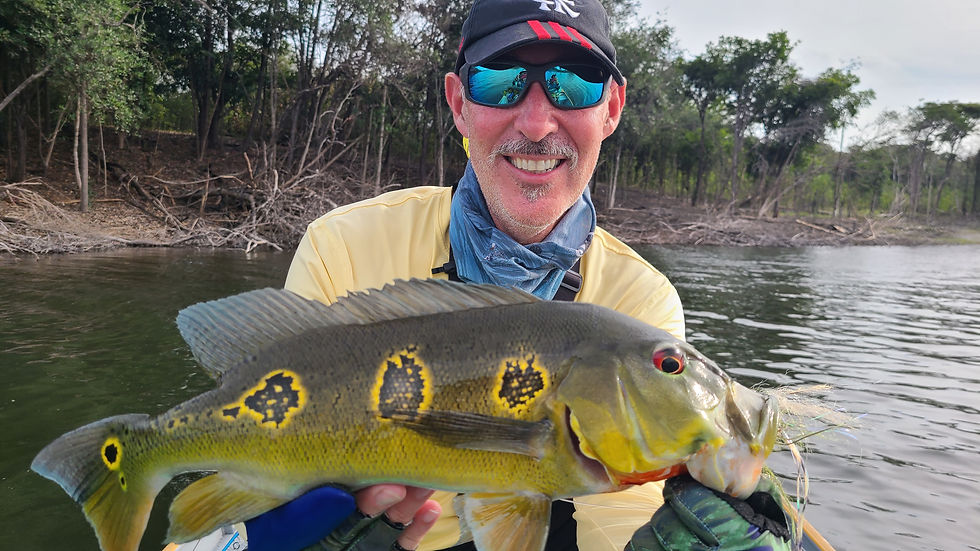

Cichla Monoculus (Popoca)
If you have ever fished for the "Temensis" in the Amazon, you have likely caught the "Popocas". Think of a Black Bass in extraterrestrial colors, and the Popocas is what you get; they are yellow, have a screaming-red breast, and their dorsal fins are blue and/or green. It's a very aggressive species, most of time hanging out in a school of Peacock Bass, and normally in the 15" range (although the brazilian record is a bit over 20"). Once you find the right spot, the "Popocas" will keep you going, and you will be forced to move to another spot after catching so many of them.
Cichla Piquiti ("Azul", as in Blue)
The "Azul" is the most popular Peacock Bass species amongst anglers in Brazil, since it can be found in lakes and rivers across various locations of thecountry, sometimes not far from large cities. To learn more about them, read my blog.
Cichla Kelberi ("Amarelo", as in Yellow)
The "Amarelo"is actually not as Yellow as its name suggests; rather kind of rusty yellow. Its vertical stripes will only go half-way to its body and it will sport have a few black spots in its belly. They are also much smaller than the Açus, reaching up to 20".
Cichla Mirianae ("Fogo", as in fire)
The Mirianae is a very unique Peacock Bass; not only because of its looks but also because it is endemic of the Tapajós and Alto-Xingú river Basins. Although the "Fogo" is mainly yellow, it has a fire-red stain that goes from the tip of its mouth and covers most of its belly. Its dorse is yellow with thin black horizontal lines, almost like a Golden Dorado. The Fogo is also known for its force, despite its size, which is in average around 17".

Now that you know a bit more about the Peacock Bass family, let's change gears and cover another very sought-after South American species, the Golden Dorados. On our next Blog of this series: Golden Dorados and Payaras. Subscribe here to be notified.


Comments